Buyer reference
Know what you are buying.
A practical reference for preparing assets, inspecting deliverables and assessing whether the evidence fits your decision.
By Oussama Nakhil · Updated 9 October 2026
Inspect an output before commissioning work
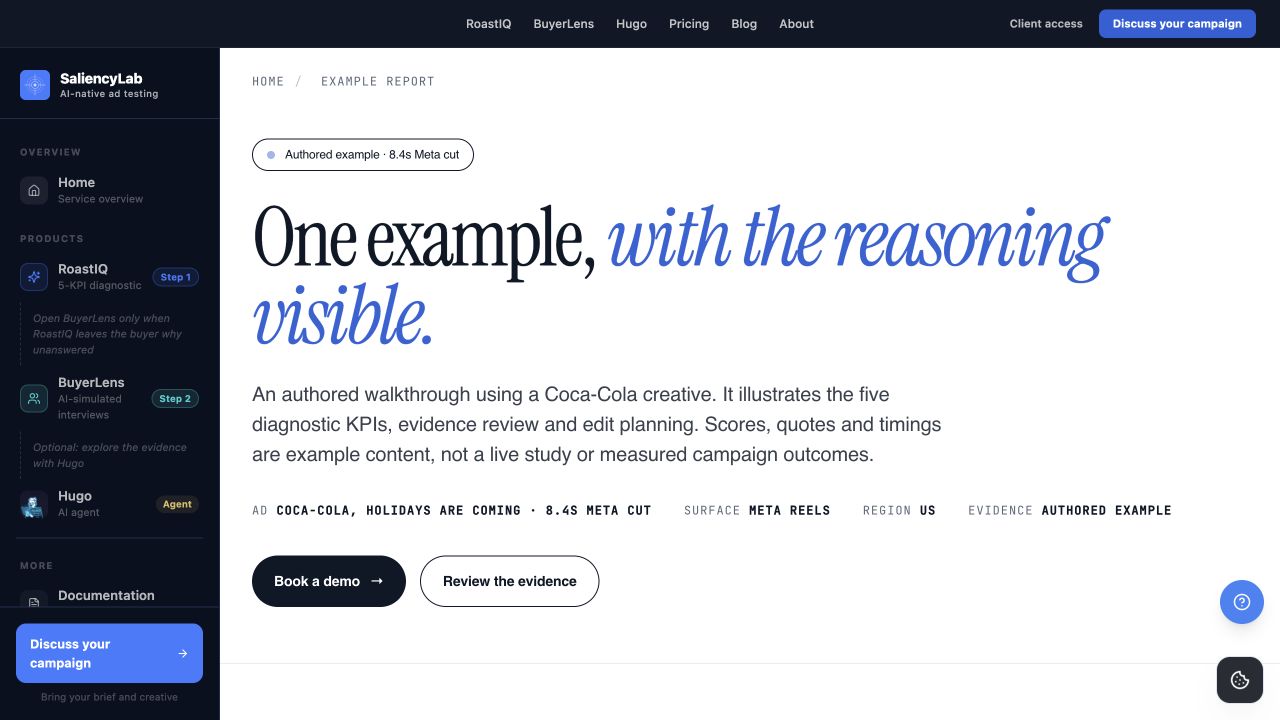
The public report demo shows the reading experience with illustrative values. The CeraVe worked case connects original frames, an archived diagnosis, a proposed brand-cue edit and a test plan. It is editorial analysis of a public ad, not a client engagement or evidence of improved results.
- Download the illustrative report image (PNG) to inspect the layout.
- Download the completed editorial decision brief (JSON): visible evidence, proposed change, uncertainty and next test. This is a worked example, not a native account export.
- Download the blank decision brief and evaluation protocol to compare providers using the same decision.
Paid software supports PDF/JSON report export. Service deliverables are agreed in the proposal and included for that engagement. A public example does not guarantee that every asset has every evidence source.
A static ad and a 30-second video need different checks
For an image, provide the original creative, placement, target market, audience and intended action. Inspect product visibility, message hierarchy and the evidence behind each suggested edit. Do not infer audio, pacing or retention from a static asset.
For a 30-second video, add the original audio and confirm the transcript. Inspect referenced frames and timestamps against the actual file. Missing speech or incomplete scene coverage can weaken a diagnosis even when a report has finished. Compare versions with a consistent brief, and change one material element when you need an interpretable experiment.
French language is not French-market validation
French is an available creative-language context and transcription language hint. RoastIQ can be instructed to generate French narrative text; KPI names remain English. This does not establish a fully localized interface, error-free transcription or validated performance for every French audience.
Check proper nouns, slang, subtitles and mixed-language audio before using recommendations. Ask to inspect an output for your exact asset and agree the language of human deliverables in the proposal. BuyerLens personas are synthetic; a French-language profile is not a recruited or representative French participant.
Procurement facts and unresolved questions
- Locations and providers
- Primary database and object storage are in Supabase EU (Paris, France). Vertex AI uses europe-west1 (Belgium) by default. Video Intelligence and Speech-to-Text use Google global endpoints; other operational sub-processors may process data internationally. See /legal/sub-processors and the DPA for the applicable transfer arrangements. Provider inventory · DPA.
- Access and model training
- Creative files use private storage and signed access URLs. The published policy says customer inputs are not used to train foundation models under the applicable provider terms. Review the security controls and privacy policy for your proposed workflow; do not assume that a public share link has the same audience as a private workspace.
- Backup retention: open exception
- The published 90-day cold-archive retention commitment remains in place, together with any shorter agreed deletion deadline. Our October 8, 2026 check confirmed archive snapshots older than 90 days and a 400-day Google Cloud cold-export lifecycle, with seven days of soft-delete recovery. The 90-day limit is not fully enforced across backup tiers. Remediation is open. This operational disclosure does not extend those deadlines or confirm that all residual copies have been erased.
- Recovery and assurance
- Limited recovery evidence does not prove full restoration of media, authentication and all historical erasures. Review the dated recovery disclosure. Internal checks and supplier certifications are not a SaliencyLab independent penetration test or certification.
- Before confidential material is uploaded
- Confirm authority to process the creative, permitted recipients, transfer requirements, retention and deletion terms. If the open backup exception conflicts with your policy, resolve that requirement before uploading; do not treat this checklist as approval.
Choose a method that can answer the question
Use diagnostics to prioritize edits. Use real interviews to investigate how people interpret a message, a properly designed consumer study for population estimates, and a controlled campaign test for observed performance. BuyerLens can suggest objections to investigate; agreement with RoastIQ is not independent confirmation.
See the method comparison, current software and service scope, and when to move from synthetic feedback to a live test.