
Prediction and recorded gaze answer different questions
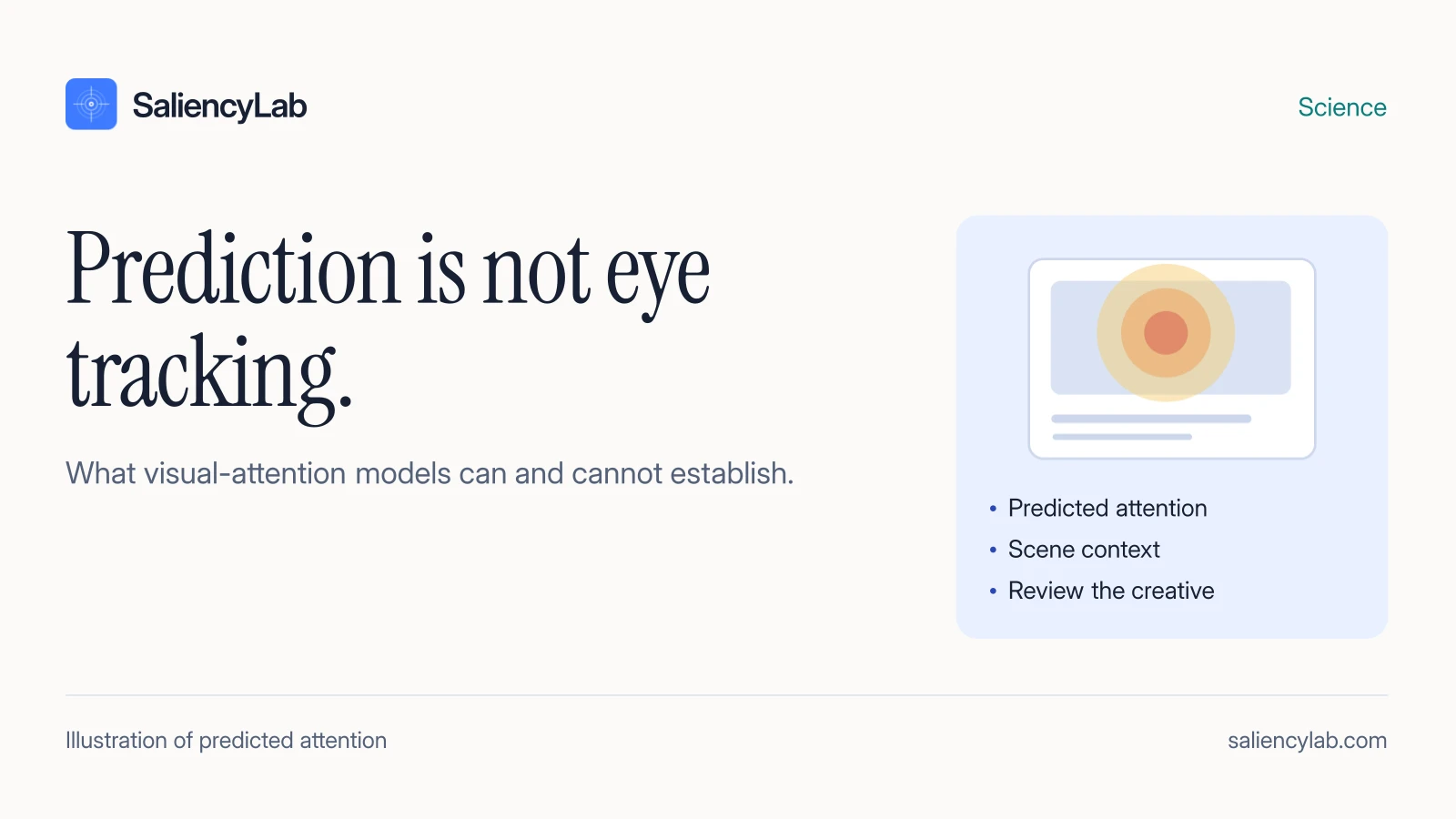
A saliency model estimates a spatial distribution from visual input. Eye tracking records gaze from recruited people under a defined viewing setup. Neither should be silently substituted for the other.
TranSalNet is an image-saliency architecture described in the original paper. Academic benchmark results concern those datasets and evaluation metrics. They are not an accuracy percentage for a particular advertisement, and they do not establish purchase intent.
Check coverage before interpretation
For video, a map belongs to its source frame. A report may analyze selected frames; an interval with no analyzed frame has no heatmap evidence. A filmstrip is not continuous eye tracking, and a static model does not establish how motion or sound redirected gaze between samples.
| Evidence shown | Supported reading | Unsupported reading |
|---|---|---|
| A frame and matching predicted map | Compare regions within that frame | “People watched the product for two seconds” |
| Several timestamped maps | Inspect the sampled moments in sequence | “Every scene was analyzed” |
| Bright region over text | Check whether important text competes successfully | “The offer was understood” |
| Little predicted emphasis on the logo | Investigate brand visibility and timing | “Nobody remembered the brand” |
Read the creative with the map
Identify the product, brand, claim and call to action on the original frame first. Then inspect the overlay. A face may attract visual emphasis while the offer stays outside the strongest region. That suggests a layout question: is the attention-grabbing element helping the message or competing with it?
Compare colors within one map. Across frames, a red region is not necessarily a higher absolute attention value unless the scale and normalization are documented. Play the original video at normal speed to assess readability and transitions that a still cannot show.
What to change
Use the map to propose a concrete edit, such as moving the benefit closer to the product or reducing competing text. Preserve the element that makes the frame distinctive. Review the revised frame and the whole cut; a cleaner still can produce worse pacing if the sequence is ignored.
No heatmap can tell you that a proposed edit will raise conversion. Message understanding needs a separate check, and actual business response needs in-market evidence.
How this relates to RoastIQ
The visual evidence sits alongside the five creative diagnostics. A heatmap is not the verdict. Check the source coverage and model identity supplied for the run; do not transfer published results from a different model into an accuracy claim for the map.
The methodology separates platform-native attribute-model validation from the five-KPI report. For practical interpretation, read ad attention heatmaps explained. For an end-to-end view, watch the demo.