
Why one number is not enough
A single AI score for an ad tells you nothing actionable. It does not explain what is wrong, where to look, or what to fix. The score might be 72, but is that good? Compared to what? And if it is bad, which part of the creative is causing the problem?
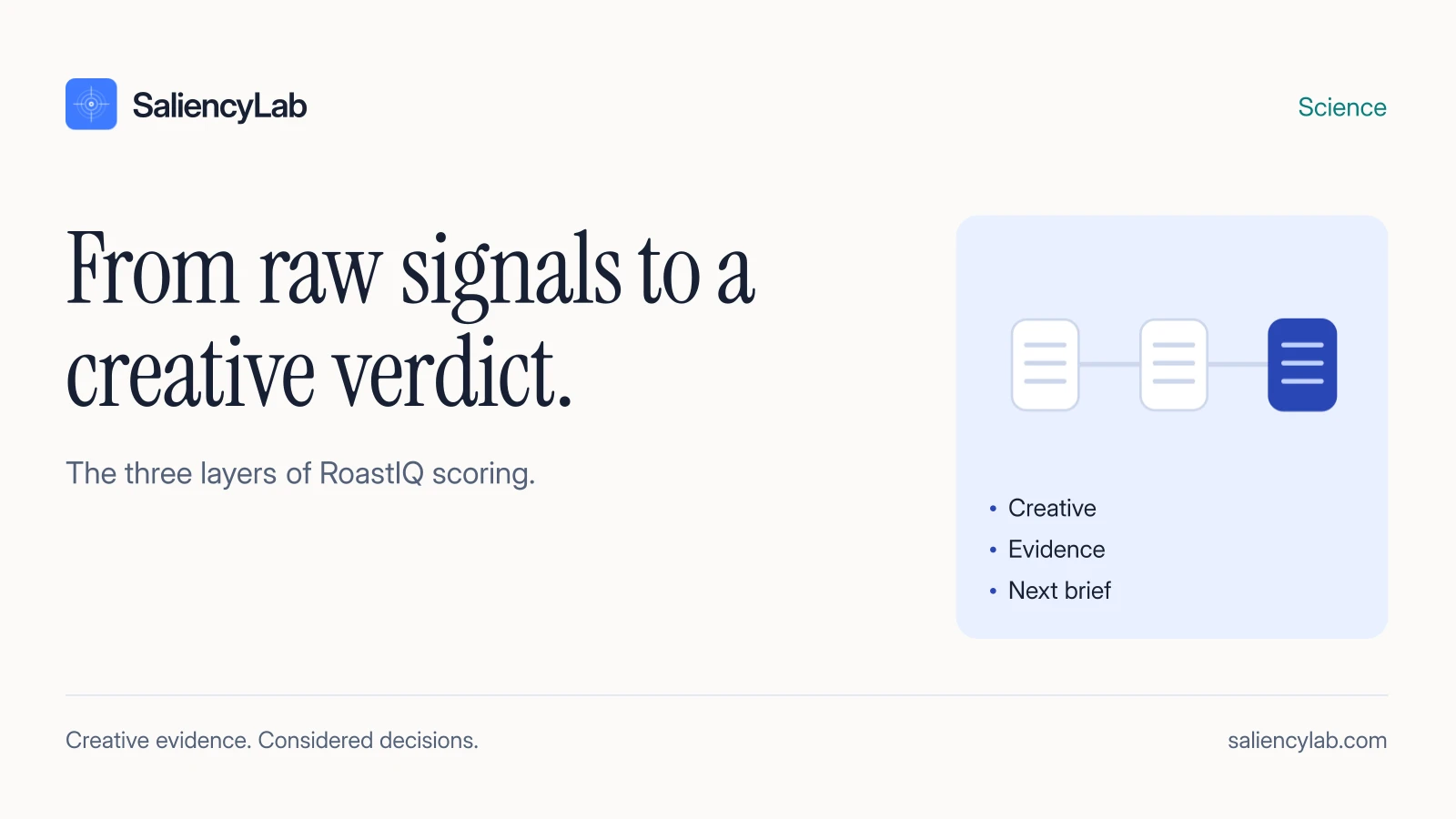
RoastIQ, the scoring engine behind SaliencyLab's pre-spend creative intelligence platform, solves this with three layers of scoring: a verdict before media budget is committed. Each layer answers a different question at a different altitude.
Layer 1: Raw perception signals
The bottom layer estimates five atomic perception signals:
| Diagnostic input | Interpret as | Do not interpret as |
|---|---|---|
| Attention | Modeled visual emphasis | Recorded gaze or watch time |
| Clarity | Estimated message clarity | A measured comprehension rate |
| Branding | Detected or inferred brand cues | Measured brand recall |
| Emotion | Model interpretation of expressive cues | Felt emotion in a recruited audience |
| CTA | Evaluation of the ask | Observed conversion |
Read the evidence coverage for the run. An unavailable transcript or unanalysed scene must not be treated as a confirmed observation.
Layer 2: Sub-KPI families
The middle layer combines raw signals into diagnostic families:
Get Noticed components: Branding, Enjoyment (Emotion), and Average Ad Viewed (Attention)
Sell Proposition components: Persuasion, Clarity, and CTA
Build Brand components: Meaningful, Different, and Salient
This layer tells you not just that Get Noticed is weak, but which component is dragging it down. Is it the branding, the emotional response, or the view depth?
Layer 3: The 5 main KPIs and composite
The top layer produces the five KPI scores that determine the verdict:
The composite weights are Beat the Skip 25%, Get Noticed 20%, Brand Impact 20%, Sell Proposition 20% and Build Brand 15%. Subcomponent formulas and available evidence are version-dependent; use the saved report’s version rather than inferring a live formula from this article.
The weighted composite then maps to one of three verdicts.
How the verdict is decided
The three verdict states are Scale, Sharpen, and Rebuild. The rules are strict, and the per-KPI floors matter as much as the composite:
- Scale: composite of 70 or above, and no individual KPI below 55
- Sharpen: composite between 55 and 69. Also any creative scoring 70 or above that has a KPI below 55, because the floor rule blocks it from Scale
- Rebuild: composite below 55, or two or more KPIs below 45
That second rule catches a case teams often miss. A creative can post a composite above 70 and still not earn a Scale verdict, because one weak KPI drags it into Sharpen. A strong average with one structural hole is not the same thing as a creative that is ready to run.
RoastIQ’s five KPIs are diagnostic model outputs. The separately reported platform-native attribute model has its own outcome-validation record; its correlations must not be attributed to the five-KPI composite, attention heatmaps or BuyerLens. See the dated methods and validation scope. None of these outputs establishes sales, ROAS or a measured human response to your ad.
Why three layers matter
A creative director who sees Sharpen with Sell Proposition at 63 can drill into Layer 2 and find that Clarity is strong but CTA is weak. Then drill into Layer 1 and see the raw CTA score. Each layer narrows the diagnosis until the fix becomes specific. For what each KPI is asking of the creative, see how to interpret RoastIQ KPI scores.
One number hides the problem. Three layers reveal it.