
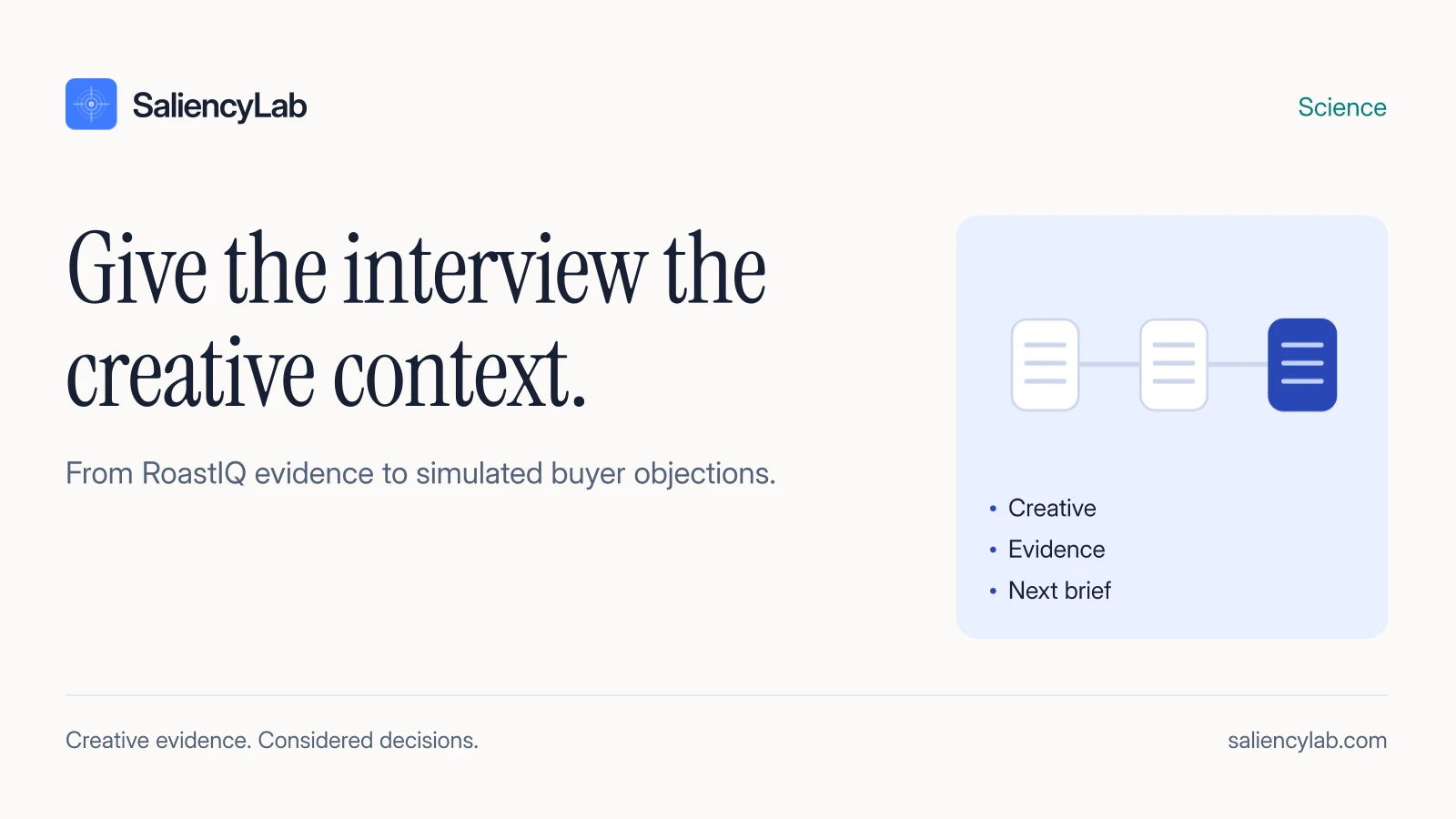
Carry the creative into the question
A useful follow-up starts with an exact asset and a defined uncertainty. “Does this explain the refill offer?” is more useful than “Do people like this ad?” Keep the creative version, intended audience, placement and offer in the study brief. Check the context visible in the current setup rather than assuming every report field or document has been passed to the interview.
The same model-generated diagnostic can influence the study that follows it. BuyerLens can help explore possible explanations; it is not an independent consumer validation of RoastIQ.
Separate context from a leading prompt
| Leading question | Neutral alternative |
|---|---|
| “The benefit arrives too late. When would you scroll?” | “What do you think the offer is? Which moment helped you understand it?” |
| “Why is the branding weak?” | “Which brand, if any, do you associate with the ad? What cue led you there?” |
| “Would an earlier product demo convince you?” | “What information would you need before considering the offer?” |
These are suggested questions, not interview results. Do not manufacture a fluent response to make the example feel complete.
Choose personas for a reason
Use buying situations that could change the interpretation: first purchase versus refill, personal use versus gifting, or a buyer checking compatibility. Write down which assumptions came from real customer research and which are exploratory.
A country label or personality trait does not make a generated profile representative. More profiles can cover more scenarios, but counts do not create statistical confidence.
Follow up on the answer itself
Start with comprehension. Then ask “Which phrase or scene gave you that impression?” If the answer identifies a concern, ask what information would resolve it without suggesting the solution. Keep the original wording alongside the follow-up so another reviewer can check the reasoning.
A source brief can improve relevance when its content is actually included. An uploaded file alone does not prove that every answer used it. Check source references where available and flag unsupported references rather than repeating them as facts.
Translate the finding into a decision
If an answer points to an ambiguous price, inspect the ad. If the price is visibly ambiguous, that observation can support an edit. If the answer says an audience dislikes the product, treat that as a research hypothesis requiring real evidence.
Preserve dissent. A single answer identifying a missing condition may matter more than several agreeable summaries. Use study-strength checks to decide whether the finding supports a small edit or needs further research.
Keep the handoff useful
The handoff should contain the exact creative, the neutral question, original simulated answers, the reviewer’s interpretation and the proposed action. Model scores, synthetic interpretations and human review should stay distinguishable.
For a complete question bank, read synthetic users for ad testing. Watch SaliencyLab to see where the diagnostic and simulated interviews fit in a creative review.