
The definition
Pre-spend creative intelligence is the practice of evaluating finished or near-finished ad creative with predictive models before media spend begins, producing a structured diagnostic (scores, benchmarks, and a verdict) while the creative can still be changed before media spend, with production and review costs still to consider. It exists for the people who decide which creative receives budget: performance marketers, agency creative strategists, and the budget holders they answer to. The decision it improves is singular and specific: should this asset receive spend as it is, be revised first, or be rebuilt?
That is the whole category in one paragraph. Everything else on this page explains why the category exists, and what it is not.
The Pre-Post Gap: why the category exists
Every ad goes through two moments of truth. The first is the creative review, when the team watches the cut and decides whether it is ready. The second is the performance dashboard, when the metrics come back after the budget has been spent.
The gap between these two moments is an opportunity to catch avoidable creative problems. We call it the Pre-Post Gap, and inside it three things are true simultaneously:
- The creative is still editable. The cut exists in a project file. Changes are possible.
- The budget is not yet committed. Media spend has not started. The cost of changing direction depends on the production work required.
- There may be no structured diagnostic signal. The team has opinions, but no structured data about how the creative is likely to perform.
The third point is the problem the category solves. Creative review relies on experience, taste, and gut feel. Those are valuable inputs, but they are not diagnostic. A structured review helps make those judgments explicit and links them to evidence other people can inspect.
Post-launch data has the opposite flaw. It is precise, but it arrives after the money has moved. By the time CPA is rising or CTR is dropping, the options have narrowed to keep spending, pause, or start over. Pre-spend creative intelligence exists because neither opinion nor post-launch data delivers a signal inside the gap, where acting on it is still cheap. The economics of that window are covered separately; the practical point is to address visible problems while the asset is still editable.
What it is not
The category is easiest to place by contrast with the four things it gets confused with.
Not A/B testing
A/B testing is a live experiment: two variants receive real spend, and the market picks the winner. It is the ground truth for comparing finished options, and nothing pre-spend replaces it. The differences are timing and cost. A/B testing happens after budget commits and charges media prices for its answer; pre-spend evaluation happens before, before media spend, with production and review costs still to consider, and tells you which variants are structurally sound enough to deserve a live test at all. One supplies diagnostic hypotheses; the other estimates differences under tested conditions. The full comparison is in AI creative scoring vs A/B testing.
Not a consumer panel
Panels and focus groups put creative in front of real people and collect stated reactions. They measure humans; pre-spend creative intelligence runs model predictions and scenario simulation. Synthetic buyer interviews, structured interviews with modeled buyer personas rather than recruited respondents, can surface likely objections in minutes, but they are hypothesis generators, not evidence about real consumers. When the stakes justify weeks and a research budget, a real panel remains the right tool. The trade-offs are laid out in SaliencyLab vs focus groups.
Not post-launch analytics
Analytics platforms tell you what happened: spend, clicks, conversions, by audience and placement. They are measurement, and they are indispensable. But they only speak after launch, and they describe outcomes without diagnosing the creative causes. Pre-spend evaluation is the other half of the loop: a forward-looking signal about the asset itself, before there is anything to measure. Teams that run both start with a diagnostic instead of a guess, then let live data correct it.
Not a generative creative tool
Generative tools make ads: variants, copy, resized formats. Pre-spend creative intelligence judges ads. The distinction matters more as generation gets cheaper, because producing twenty variants in an afternoon is now easy, and deciding which of the twenty deserves budget is the new bottleneck. Evaluation is unrelated to production volume; it is the quality gate that sits after any generator, human or AI.
What the signal looks like in practice
In SaliencyLab's implementation, RoastIQ returns a diagnostic across five fixed KPIs (Beat the Skip, Get Noticed, Brand Impact, Sell Proposition, Build Brand) with benchmark context and a verdict of Scale, Sharpen, or Rebuild, with processing time depending on the asset and service conditions. A typical pass looks like this: a team uploads three candidate cuts, one comes back Rebuild with a weak opening, one comes back Sharpen with late brand entry, one comes back Scale. The Rebuild is reviewed before media spend, the Sharpen gets a targeted fix and a rescore, and the live test runs on two viable variants instead of three unequal ones. Reading the output well is its own skill: see how to read a RoastIQ report, and the full pre-launch workflow for where the diagnostic sits in the end-to-end process.
The evidence, stated plainly
RoastIQ’s five KPIs are diagnostic model outputs. The separately reported platform-native attribute model has its own outcome-validation record; its correlations must not be attributed to the five-KPI composite, attention heatmaps or BuyerLens. See the dated methods and validation scope. None of these outputs establishes sales, ROAS or a measured human response to your ad.
Moderate correlations, honestly labelled, are the right expectation for the category. They support ranking creative and catching structural weakness before spend. They do not support treating any score as a forecast of campaign results.
What this can and cannot tell you
- It can tell you whether an asset clears a structural bar before it receives budget, which perception dimension is weakest, and how the creative sits against a benchmark pool. Those are facts about the model's output, backed by the validation above.
- It should shape, not make, your decision. Treating a Rebuild verdict as a hard stop and a Sharpen as a revision prompt is our recommendation, a review policy you should adapt to the evidence and decision.
- It cannot tell you whether the market wants the offer, what a competitor will do, or what your sales number will be. Attention heatmaps in this category are predictions of where viewers will look, not eye-tracking measurements. Synthetic buyer output is simulation, not consumer evidence. Live results remain the ground truth, and a team that stops checking predictions against them is using the category wrong.
The gap is the point
The Pre-Post Gap is not closed by better dashboards or bigger panels, because both operate outside the window where change is cheap. It is closed by a signal that arrives while the project file is still open. That is the entire premise of pre-spend creative intelligence: not a prediction of success, but a structured diagnostic while the ad is still editable.
If you want to see what that signal looks like on a real creative, the example report shows the full diagnostic, verdict and evidence included.
Keep the evidence types separate
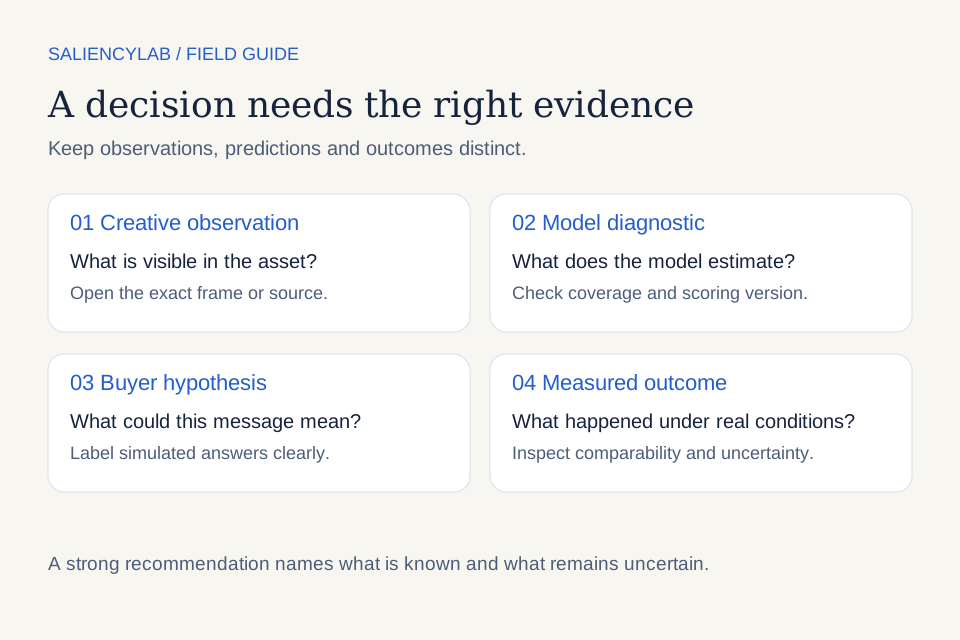
The diagram is a reading framework. It does not imply that every project contains all four evidence types. The decision matrix includes an explicit “insufficient evidence” option when the material does not support a confident choice.