
What changed in v3
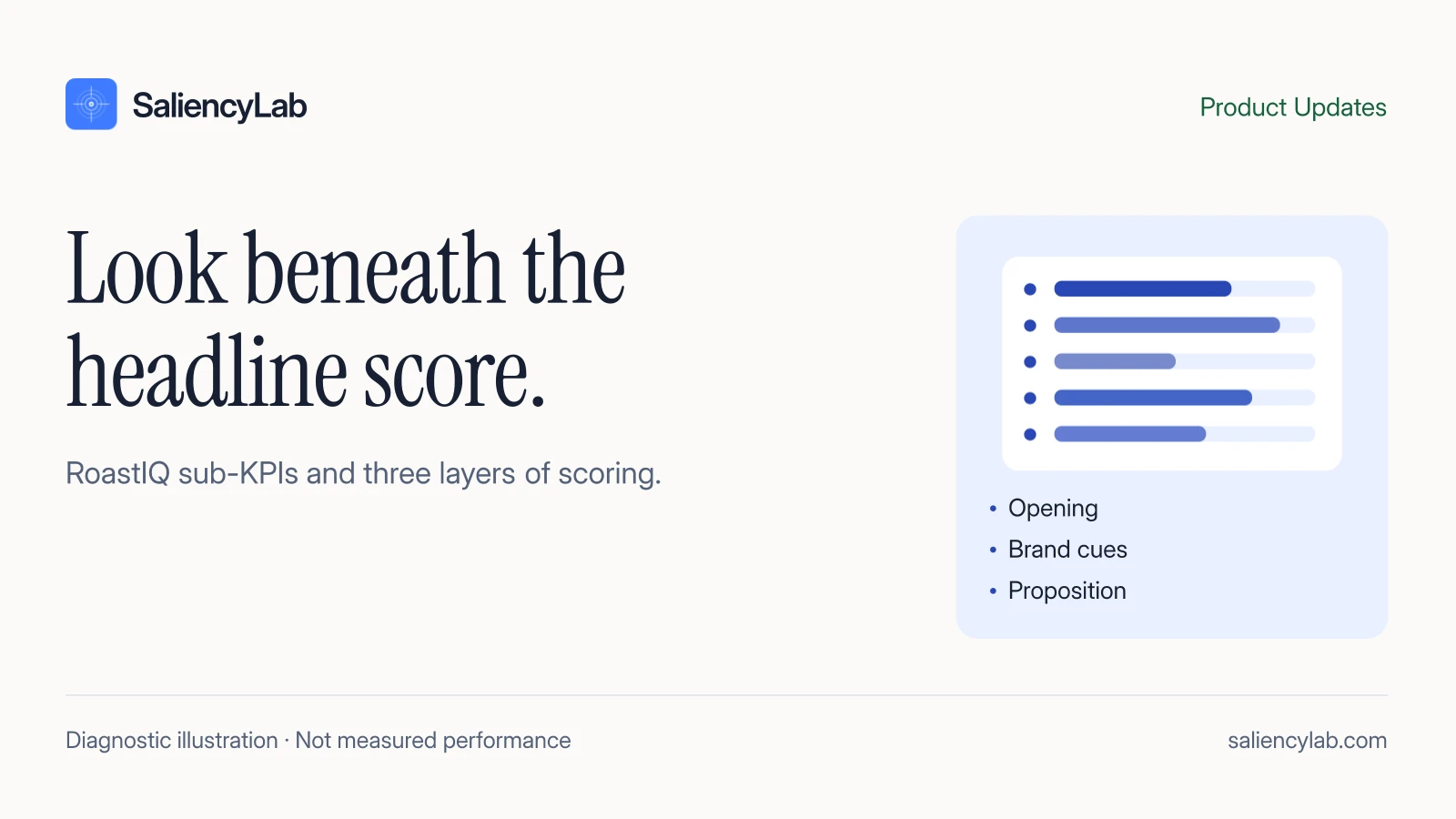
RoastIQ v3 introduces three layers of scoring where previously there was one. Instead of just seeing that Sell Proposition scored 63, you now see why: Persuasion is strong, but CTA is weak at 42.
The three layers
Layer 1: Raw signals. Attention, Clarity, Branding, Emotion, and CTA, each scored 0 to 100.
Layer 2: Sub-KPI families.
- Get Noticed: Branding, Enjoyment, and Ad Viewed
- Sell Proposition: Persuasion, Clarity, and CTA
- Build Brand: Meaningful, Different, and Salient
Layer 3: Main KPIs and composite. The 5 weighted KPIs that determine the verdict.
Why this matters
A creative director who sees Sell Proposition at 63 can now drill into Layer 2 and find that Clarity is strong but CTA is weak. Then drill into Layer 1 to see the raw CTA score. Each layer narrows the diagnosis until the fix is specific.
The practical difference is what you write in the brief. "Sell Proposition is weak" is not an edit instruction. "The CTA is weak at 42 while Persuasion is strong" narrows the question, but still needs source evidence. A usable instruction identifies the scene, the unclear ask and what the editor should preserve. The numbers here are illustrative.
One number hides the problem. Three layers reveal it.
What stays the same
The 5 KPI names are unchanged: Beat the Skip, Get Noticed, Brand Impact, Sell Proposition, Build Brand. The weights are unchanged (25%, 20%, 20%, 20%, 15%). The verdict thresholds are unchanged. The composite formula is unchanged.
Stable KPI names and weights do not guarantee cross-version comparability. Compare the scoring version, input context and benchmark definition before interpreting a change. If those differ, label the comparison as cross-version and avoid attributing the whole score movement to the edit.